Kategorie-Archiv: Research output

Enhancing NK Cells Anti-Tumor Activity with Caripe 8 from Carapichea Ipecacuanha

A research paper, entitled ‚Boosting the anti-tumor activity of natural killer cells by caripe 8 – A Carapichea ipecacuanha isolated cyclotide‚, was published in the Elsevier Journal of Biomedicine & Pharmacotherapy [IF 6.9, Top 5% in Pharm. & Pharmacy].
Here is the link to online version of the article: https://doi.org/10.1016/j.biopha.2024.117057.

In this research, plant extracts were found to increase the effectiveness of cytotoxic NK cells. The compound caripe 8, derived from Carapichea ipecacuanha, enhanced the function of both mouse and human NK cells, leading to tumor cell death. The authors observed that caripe 8 directly activated NK cells to induce tumor cell death.

List J, Gattringer J, Huszarek S, Marinovic S, Neubauer H, Kudweis P, Putz EM, Hellinger R.*, Gotthardt* G, Boosting the anti-tumor activity of natural killer cells by caripe 8 – a Carapichea Ipecacuanha isolated cyclotide. Biomed Pharmacother, 2024;177,117057. doi: https://doi.org/10.1016/j.biopha.2024.117057. * equally contributing corresponding authors.
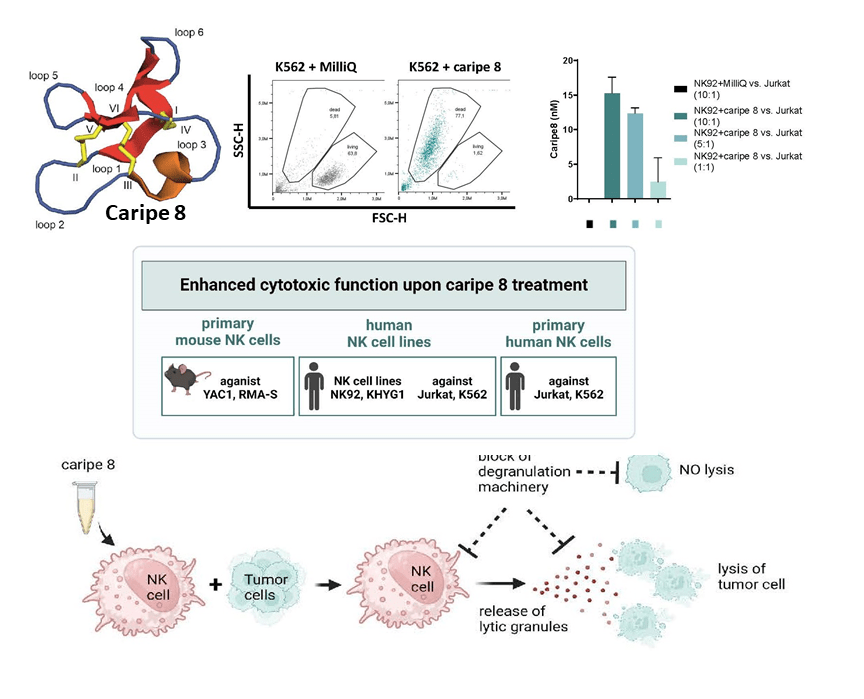
Caripe 8 enhances NK cell cytotoxicity toward target cells.

A new phytocannabinoid peptide has been disovered in Viola.

A research team led by Christian Gruber from MedUni Vienna and supported by the PeptAIDes team has discovered a new phytocannabinoid in sweet violet plants (Viola odorata). The peptide interacts with a specific receptor that does not trigger psychoactive effects and, due to its molecular properties, could spark the research and development of novel drugs for the treatment of autoimmune diseases, pain, or chronic inflammation. The results of the study were recently published in the „Journal of Biological Chemistry.“.

More can be read using these links:

https://www.meduniwien.ac.at/web/en/about-us/news/2024/news-in-april-2024/new-phytocannabinoid-discovered-in-sweet-violet

Discovery and development of macrocyclic peptide modulators of the cannabinoid 2 receptor.
Nataša Tomašević, Fabiola Susanna Emser, Edin Muratspahić, Jasmin Gattringer, Simon Hasinger, Roland Hellinger, Peter Keov, Manuel Felkl, Jürg Gertsch, Christian F.W. Becker and Christian W. Gruber.
DOI: 10.1016/j.jbc.2024.107330

Nature Reviews Methods Primers: Peptidomics

In recent collaborative work, our team reviewed the research field ‚Peptidomics‘ in a Nature Reviews Methods Primers article.

‚Peptidomics, the comprehensive qualitative and quantitative analysis of all peptides in a biological sample, is an emerging field derived from proteomics and enabled by modern separation, analytical and computation technologies. … This review describes applications of peptidomics and modern approaches for peptide extraction, fractionation, detection, quantification, functional annotation, and structural prediction.‚ (Hellinger R et al. 2023).

Hellinger R., Sigurdsson A., Wu W., Romanova EV., Li L., Sweedler JV., Süssmuth RD., Gruber CW. Peptidomics. 2023. Nat Rev Methods Primers, 3, 25. https://doi.org/10.1038/s43586-023-00205-2.

Peptide modulators of cell migration: Overview, applications and future development

Jasmin Gattringer, Christian W. Gruber and Roland Hellinger published a review article in Drug Discovery Today on peptide cell migration inhibitors.

The article is available here.

Gattringer J, Gruber CW, Hellinger R. Peptide modulators of cell migration: Overview, applications and future development. Drug Discov Today. 2023 Mar 13:103554. doi: 10.1016/j.drudis.2023.103554. PMID: 36921670.

All-atom molecular dynamics simulations of the hERG1 channel 

Eva-Maria Zangerl-Plessl (Principal Iinvestigator) first authored a peer review publication in Frontier in Molecular Biosciences (IF 4.6). The title of the work is ‚Binding of RPR260243 at the intracellular side of the hERG1 channel pore domain slows closure of the helix bundle crossing gate‘.

The article is downloadable on the publishers website and here doi.org/10.3389/fmolb.2023.1137368.

« Ältere Einträge Letzte Einträge »